Beyond Grime: Why British Producers Are Writing the Rules for the Whole World
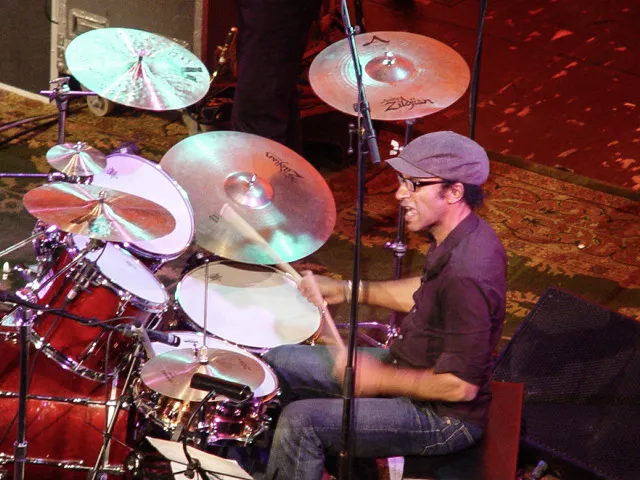
Photo: Hreinn Gudlaugsson, CC BY-SA 4.0, via Wikimedia Commons
There's a version of this story that starts with grime, moves through UK garage, name-drops drill, and wraps up with a tidy conclusion about how Britain keeps reinventing urban music. It's a good story. It's also, at this point, a slightly tired one — because it misses the more interesting thing that's actually happening.
British producers aren't just dominating the genres they created. They're reshaping genres they had nothing to do with. Afrobeats. Hyperpop. Neo-soul. Experimental electronic. Latin-influenced club music. In studio after studio — in Peckham, in Manchester, in Birmingham, in places that don't make it into the music press nearly enough — UK producers are exporting a sensibility that the global industry is quietly treating as a gold standard.
So what's actually going on? And why Britain, why now?
The Production Mentality
Part of the answer is structural. The UK has, over several decades, built up an extraordinarily dense ecosystem of production talent. The bedroom producer culture that emerged in the late 90s and early 2000s — kids teaching themselves on pirated software, sharing techniques in forums, collaborating across cities before collaboration tools were properly a thing — created a generation of producers with unusually broad technical vocabularies.
These aren't people who learned one genre and stuck to it. They grew up absorbing grime, jungle, house, hip-hop, indie, and classical all at once, because that's what British culture serves up. The eclecticism isn't a marketing position — it's just what happens when you grow up in a country where Radio 1, pirate radio, and your mate's older brother's record collection are all competing for the same ears.
That breadth of reference translates into a willingness to move across genre lines without anxiety. A British producer working on an Afrobeats track doesn't feel the need to replicate what Lagos sounds like — they bring something distinctly theirs to the session, and increasingly, that's exactly what artists from Lagos, Atlanta, and Lagos via Atlanta are looking for.
The Afrobeats Connection
The relationship between British producers and Afrobeats is probably the most visible example of this cross-cultural dynamic right now. London's West African diaspora communities have been central to the UK Afrobeats scene for years, but the production talent feeding into that scene — and increasingly into the Nigerian and Ghanaian mainstream — draws from a much wider pool.
Producers who came up making UK funky, or grime, or even post-dubstep electronic music have found that their instincts translate remarkably well to Afrobeats production. The rhythmic complexity, the relationship between bass and percussion, the way space is used in a mix — these are things that UK production culture has been obsessing over for decades. It turns out those obsessions are highly portable.
The traffic isn't one-way, either. The influence of Afrobeats on British pop production has been significant and growing. What's emerged from that exchange is something genuinely new — a hybrid sensibility that doesn't belong entirely to either tradition, and that's starting to define what contemporary British pop sounds like to outside ears.
Hyperpop and the Willingness to Break Things
If the Afrobeats story is about cultural exchange and community, the hyperpop story is about something slightly different: a very British willingness to push aesthetics until they break, and then keep pushing.
The genre — if you can call it that — emerged from a loose network of producers and artists, many of them British or UK-based, who were essentially asking what happened if you took every pop convention and turned it up until it became something else entirely. Pitch-shifted vocals, hyper-compressed production, melodic structures that shouldn't work but somehow do. It was chaotic, self-aware, and deeply weird.
It was also, it turned out, hugely influential. The hyperpop aesthetic has filtered into mainstream pop production in ways that are now almost invisible — a processed vocal here, a distorted synth texture there. The people who pioneered it were largely working outside any commercial framework, which gave them the freedom to be genuinely experimental. That freedom is something the UK's independent production scene has historically been good at protecting.
The Studio as Cultural Space
One thing that comes up repeatedly when you talk to British producers about why they think UK production has this particular quality is the concept of the studio as a social space. In many parts of the world, production is a relatively solitary or hierarchical activity — the producer is a specialist brought in to do a specific job. In the UK, particularly in cities like London, Manchester, and Birmingham, there's a long tradition of the studio as a place where different scenes and genres cross-pollinate.
Grime producers ended up in sessions with jazz musicians. Electronic artists found themselves collaborating with grime MCs. Neo-soul vocalists worked with producers whose primary reference points were Detroit techno. These collisions — sometimes awkward, often generative — produced sounds that wouldn't have existed otherwise. And they produced producers who are genuinely comfortable operating at the intersection of different musical worlds.
That comfort is, in itself, a kind of cultural export. When a British producer joins a session in Lagos or New York or Seoul, they bring a collaborative instinct that's been shaped by this history of cross-genre exchange. It changes the dynamic of the room.
Identity Without Anxiety
Perhaps the most striking thing about the British producers making waves internationally right now is how clearly British they remain, even when working in genres that have nothing to do with the UK's own musical heritage. There's no attempt to disguise where they're from, no effort to sand down the distinctiveness of their perspective in order to fit into someone else's template.
This cultural confidence — the ability to engage deeply with another tradition while remaining grounded in your own — is genuinely rare. It's also, arguably, what makes British production so valuable to international artists. They're not looking for someone who'll replicate what they already have. They're looking for someone who'll bring something genuinely different to the table.
The UK music industry has spent a long time worrying about whether British artists and producers can compete globally. The evidence from the studio floor suggests that question has already been answered — and the answer is more interesting than anyone expected.
The Next Chapter
What comes next is harder to predict, which is probably a good sign. The most exciting developments in British production right now are happening in spaces that don't have names yet — genre hybrids, sonic experiments, collaborative projects that don't fit any existing category. That's where the real innovation lives, and it's where British producers have always been most comfortable.
The world is still catching up with what's already been made. By the time it does, the UK will have moved on to something else entirely.