Same WiFi, Different Worlds: How British Music Lost the Magic of Being in the Room
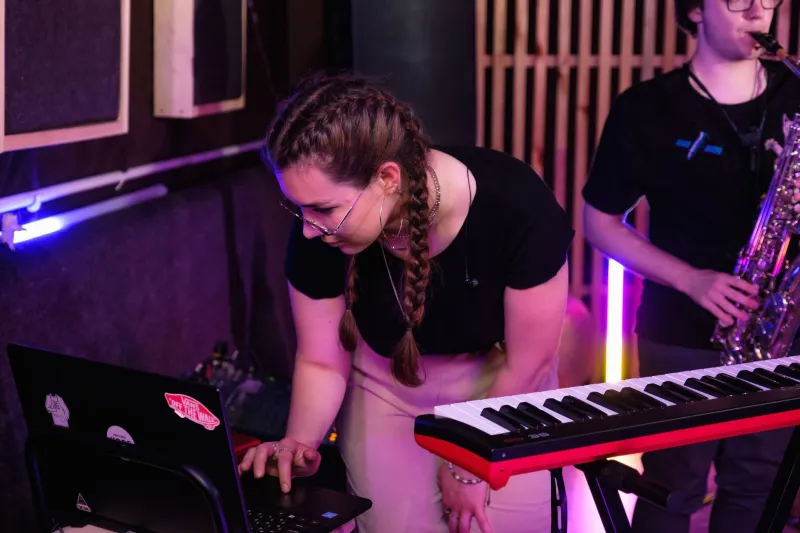
There's a producer in Salford — let's call him Marcus — who released one of the most-talked-about EPs in the UK underground last year. Warm, layered, unmistakably human-sounding. The kind of record that makes you think a group of mates stayed up all night in a smoky studio, arguing over basslines and eating terrible takeaway. Except none of that happened. Every single contributor to that project sent files over WeTransfer. Marcus never met most of them in person. One vocalist recorded their part in a wardrobe in Wolverhampton. Another played keys in a flat in Edinburgh. The whole thing was assembled like a jigsaw puzzle, piece by piece, across a broadband connection.
"It sounds great," Marcus admits. "But I genuinely don't know if I made it with those people, or just used them."
That distinction — between genuine collaboration and sophisticated file-sharing — is becoming one of the more uncomfortable questions sitting at the heart of British music right now.
The Pandemic Broke Something That Hasn't Been Fixed
It's easy to forget how radically COVID-19 restructured the way UK artists worked. Studios closed. Sessions were cancelled. Bedroom production, already on the rise, became the only option. And the industry adapted — impressively, in many ways. Artists got creative. Remote collaboration tools improved. The music kept coming.
But now, several years on, many musicians are quietly acknowledging that what started as a workaround has calcified into a default. The studio session — once the beating heart of British music culture, from the legendary Trident Studios sessions of the 70s to the early grime cyphers in east London — has been replaced, for a huge number of artists, by a folder of stems and a Notion board.
"The pandemic gave everyone permission to work alone," says one London-based A&R who asked not to be named. "And a lot of people discovered they preferred it. Less friction. More control. But you lose something. You lose the accidents."
Those accidents — the wrong note that becomes the hook, the offhand comment that redirects the entire song, the chemistry that only exists when people physically occupy the same space — are precisely what defined so many of Britain's most celebrated musical moments. Britpop was built in rehearsal rooms. Jungle evolved in pirate radio stations where producers and MCs were crammed together. Even early grime, for all its bedroom-produced aesthetics, was shaped by the friction and energy of people in close proximity.
When Connectivity Becomes a Substitute for Connection
Here's the paradox: British artists have never been more technically capable of collaborating with anyone, anywhere, at any time. Splice libraries, shared Ableton projects, real-time audio tools — the infrastructure is extraordinary. And yet, speak to enough producers and songwriters and a consistent theme emerges. Something about the quality of collaboration has thinned out.
"You can send someone a track and they send back a verse and it's fine," says Priya, a singer-songwriter based in Bristol who's worked with producers across the UK and Europe. "But 'fine' isn't what makes great music. Great music comes from tension, from someone pushing back, from the conversation that happens when you're both staring at the same screen in the same room and one of you goes, 'no, wait, what if we just stripped it all back?' You can't replicate that on a voice note."
There's also the question of trust. Creative vulnerability — the willingness to try something embarrassing, to fail in front of someone, to share a half-formed idea before it's ready — is much harder to access through a screen. Physical presence creates a kind of psychological safety that video calls, for all their convenience, simply don't replicate. You're not going to hum an uncertain melody into your laptop camera the same way you might in a room where the vibe is right.
The Rise of the Algorithmic Ghost
Layered on top of all this is a newer, thornier issue: the quiet creep of AI-assisted production and algorithmic ghostwriting. It's not that AI is suddenly writing all the hits — it isn't, at least not yet. But the tools are increasingly present in the workflow, and they're changing the nature of creative input.
Some artists are using AI to generate chord progressions, melodic ideas, or even lyrical starting points. Others are licensing beats from platforms that use machine learning to generate production at scale. And in a landscape where the line between collaboration and outsourcing was already blurring, the introduction of AI muddies things further still.
"I've had people pitch me tracks where I genuinely couldn't tell how much of it was them," says one independent label manager based in Manchester. "Not because AI sounds indistinguishable from humans — it doesn't, not really — but because the human contributions were so minimal. It was more like... curation. Which is a skill, sure. But is it collaboration?"
The question isn't academic. British music has always derived its cultural power partly from the sense that it comes from somewhere — from communities, scenes, relationships, arguments, shared experiences. When the process becomes sufficiently atomised, that sense of origin starts to evaporate.
What's Actually Being Lost
None of this is to say that remote collaboration is inherently lesser, or that bedroom production can't yield extraordinary results. It clearly can and does. But the concern among many working musicians is that the habit of physical collaboration — the muscle memory of being in a room, reading the energy, responding in real time — is atrophying.
Scenes, historically, have been built on geography and proximity. Manchester's Madchester moment. Sheffield's electronic underground. London's garage and grime eras. These weren't just stylistic movements; they were social ones, forged in specific venues, studios, and streets. The worry is that without the physical infrastructure of collaboration, the next generation of distinctly British scenes might never properly coalesce — that instead of movements, we'll get moments: viral, isolated, rootless.
"I think we're producing more music than ever and fewer scenes than ever," Priya says. "And I'm not sure those two things are unrelated."
Can It Be Rebuilt?
There are people actively trying. Across the UK, small collectives and studio co-operatives are pushing back against the isolation — deliberately creating spaces for in-person sessions, writing camps, and collaborative residencies. Some are funded through Arts Council grants. Others are just mates with a shared rehearsal space and a determination to make something together.
It's not a revolution, but it might be a corrective. A reminder that for all the tools at our disposal, some things about making music haven't changed: the best ideas still tend to happen when people are actually, physically, in the room.
Marcus, for his part, is planning his next project differently. He's booked a studio in Manchester for three days. He's invited two producers he's only ever spoken to online. He has no idea what they'll make.
"That's kind of the point," he says. "I want to not know what's going to happen. I haven't felt that in a while."