Cassette to Collab: Why the Made-for-You Tracklist Is Britain's Most Enduring Love Letter
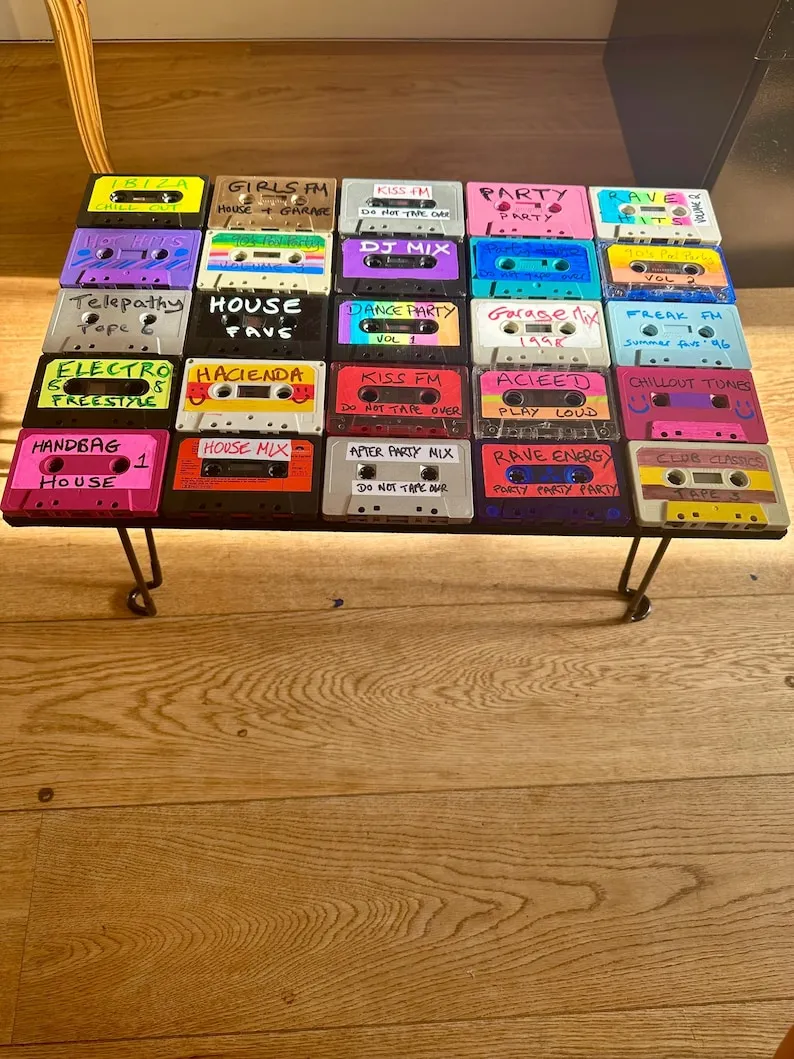
Photo: handmade cassette mixtape with handwritten label on wooden table, via i.etsystatic.com
There's a shoebox in my mum's loft that contains, as far as I know, the entire emotional history of my teenage years. It's full of cassettes. Hand-labelled, tracklists written in biro on the paper inserts, the occasional smudge of Tipp-Ex where I'd changed my mind about the opening song. Some were for me. Most were for other people.
That second category — the made-for-someone-else tracklist — might be the most quietly British art form we've got. And it hasn't died. It's just moved house.
The Biro Era
Ask anyone who grew up here between roughly 1975 and 2005 and they'll tell you about the ritual. Recording songs off the radio meant sprinting to hit pause before the DJ talked over the intro. The best compilations had a logic to them: side one was the statement, side two was the confession. You couldn't skip. You couldn't shuffle. You were stuck with someone's choices, and that was the whole point.
A good tape said things you couldn't say out loud. A great one said them in an order that made the other person cry on the number 43 bus. Nobody wrote that down as a rule, but everybody knew it.
Burn, Rip, Repeat
The CD era made things faster but not, somehow, better. Burning a disc for a mate took eleven minutes instead of a whole evening, and something got lost in the efficiency. Then the iPod arrived with its auto-playlists, and for a while it looked like the whole tradition would be automated into oblivion.
It didn't happen. Because the compilation was never really about the music.
It was about proof of attention. The hours it took to make one was the message. An algorithm can guess what you like; it cannot know that a particular song reminds you of a particular night in a particular pub in Manchester. Only a mate can do that.
The Four-Hour Epic
Which brings us to now. Talk to anyone under thirty about playlists and you'll find the form hasn't just survived — it's ballooned. The modern British compilation is a four-hour monument. Collaborative playlists between flatmates, couples, long-distance friends. Titles that are basically in-jokes. Playlists built over years, added to at 2am, treated less like mixtapes and more like shared diaries.
The curators I spoke to all said versions of the same thing: the length is the point. A three-minute song is a message; a four-hour playlist is a relationship. You dip in and out of someone's taste the way you'd dip in and out of their life.
And there's a quiet rebellion in it, too. Streaming wants you passive — fed, sorted, automated. Making a playlist for one specific human is the last truly analogue gesture left in a digital format. The medium changed; the impulse didn't.
Why It Still Matters
There's a reason we still talk about the tapes people made us decades later, and it's not nostalgia for cassette hiss. It's that being curated by someone — properly considered, sequenced, argued over — is one of the few unambiguous acts of love available to British people who'd rather die than say what they mean.
The mixtape is dead. Long live the playlist. Same biro, different paper.